Aline oat maas
Zaghafter breakthrough
The dance performance "Fabelhaft" by Veronika Heisig and Manuel Lindner invites you to re-experience bodies and their movement patterns.
The text was written on the blog of the "Berliner Schaufenser" event series of the Theater o.N.
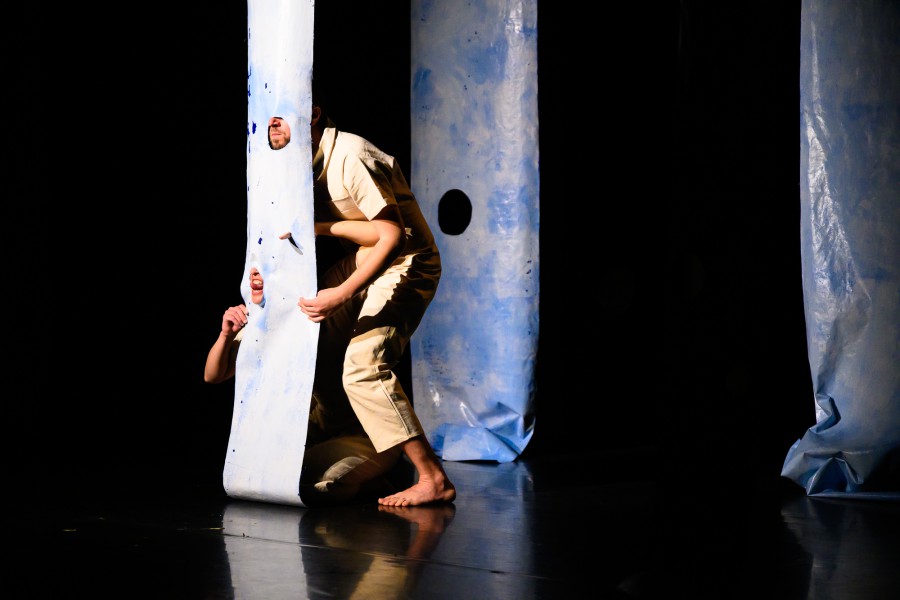
The forehead wrinkles crumble through the hole as if they were an independent being. An elbow pushes out and squeezes through the small opening. Organic, a bit unfamiliar. Fingers like probes explore the room and timidly dare the breakthrough. One mouth, one ear, one nostril.
The body parts are familiar to us all, but in the 25-minute dance performance by Manuel Lindner and Veronika Heisig they appear unexpectedly independent: As individual living beings that function self-sufficiently and depict the human body only by chance in this arrangement for a brief moment. Fragmentarily, the big picture forms, soon a strong arm, a long leg shows up. The individual parts are formed into two performers, who will design this afternoon for children from the age of four at the FELD Theater for young audiences in Schönberg.
The stage design is kept simple and stretches in paths of tarpaulins – like strands of water flowing down from above and into the audience. The strands have holes of different sizes and heights. This is about deconstruction and sensitization for the little one: a blink stands for itself. Ears without context. It is a curious image that breaks down the familiar body into its individual parts. Unusual and playful. The bodywork is accompanied by fast snapping and shapes the atmosphere in the audience. A child asks aloud, ‘When do they start dancing?’
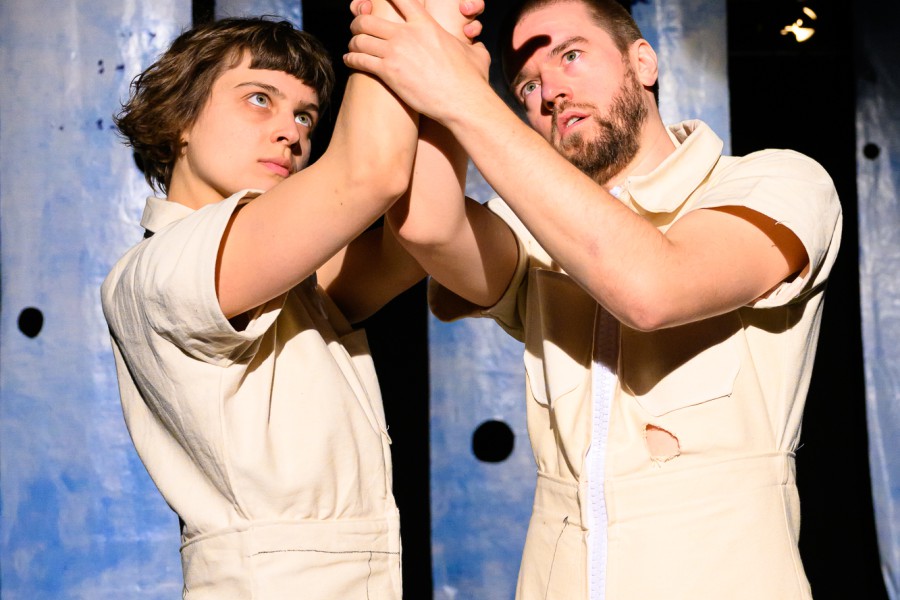
About half of the piece, the artists emerge behind the tracks and experiment together in space with different types of movement. The starting point for this is again the body in its individual parts – but this time in connection with the other person. Out of the connection of the hands grow chains of movement. The movements of one person are transferred to the other. The movements are mechanical, researching and irritating to the usual view of the body – and how they move as expected.
A brief moment of silence pauses, the two dancers separate spatially. One child asks: ‘Why is it quiet now?’
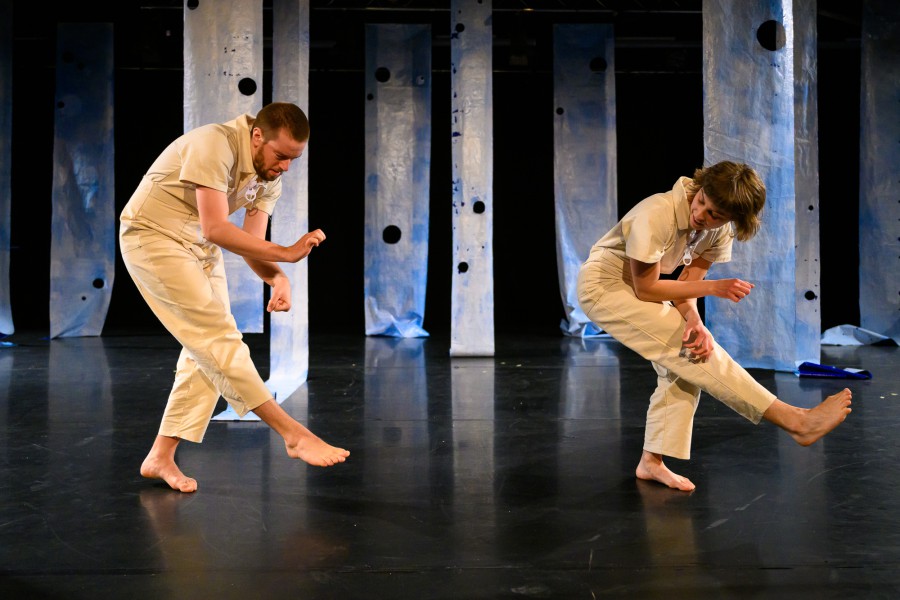
The tension breaks open and with jerky, strong and proud movements the dancers take up space. They shift the focus away from their body and its details towards external perception. They make their movement language work. At times, a person has their solo moment before they dance a little choreography together again. Again, the usual picture is disturbed and visible to the viewers: There is no prescribed type of movement, every body can and may try something new.
The mental state can affect our body, especially our posture. Conversely, our posture can also affect our psyche and evoke certain emotions.
The official performance ends after 25 minutes, but now the great fun begins: the moving playback time. The children are invited to look at the stage and explore together with the dancers. Many children take their parents with them for safety, almost all accept the offer. First, it's about getting to know the stage. How does the floor feel? What is it like to sit under the headlights? Then research begins on your own body. The children explore their hands in fast, leisurely, large and small-scale movements. The circle is broken up, the children meet each other in the room and begin to experiment and try out themselves. After the energetically charged dance performance, they are finally allowed to dance and move. They use the tarpaulins to test for themselves what it is like to move and stage body parts in isolation. They dance with others and observe where body boundaries merge and break open. How much closeness and how much space do I need myself and how much my counterpart?
After ten minutes, the two dancers animate to break up the usual habit of movement and try out jagged, angular, delimiting and proud movements. Some children are guided by the offer, others have already dived into their own world of movement.
Fabulous © René Löffler
The performance impresses with its connectivity. No language skills are required to understand what is happening on stage. Even at the playback time can be easily participated without previous knowledge. In addition, the play encourages imitation and experimentation in the theater. This is particularly good for children, even if they are not able to concentrate for a very long time or have a strong urge to move, as it gives them the opportunity to combine the theatre experience with the feeling of playback time.
This work and the follow-up time stimulate unknown or perhaps rarely tested movement patterns. Since attention is also explicitly drawn to fast and delimiting or proud postures and movements, this performance offers the opportunity to try out similar movements and experiment with them. It can be helpful to be able to try out in this playful context how proud, jagged and delimiting movements feel and to try them out. In addition, in the after-play time, it is made possible to experience what it is like to be on stage and to be in the spotlight. Children get the opportunity to explore their bodies anew and in encounter with other bodies.
A father says to his daughter: ‘That wasn’t a puppet theatre.’ The girl shakes her head: ‘No, it was theatre!’
Fabulous © René Löffler