Elisabeth Leopold
Small big jumps
Sample recording and interview
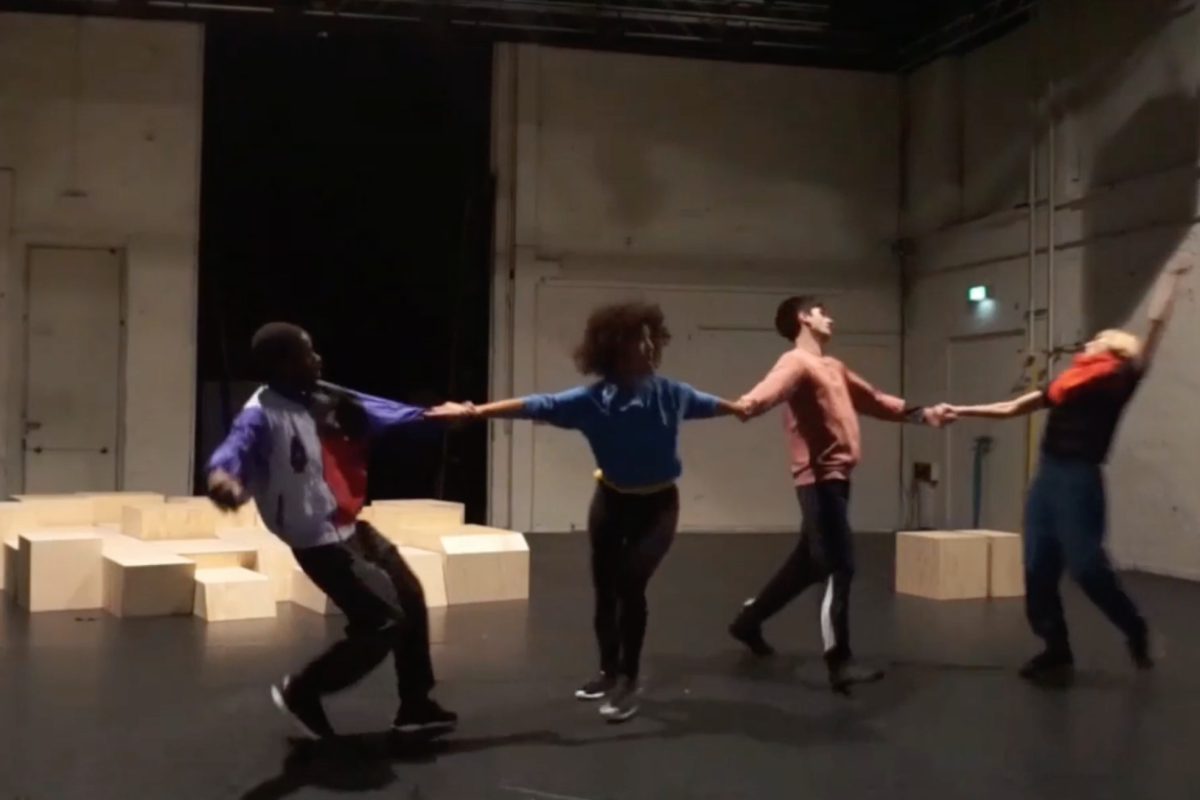
As part of the offensive dance for young audiences, the play “Kleine große Sprünge” (Small Big Jumps) would have premiered on 23 April. Unfortunately, due to the Covid-19 pandemic, this has to be postponed until further notice. However, we are already pleased to be able to give an exciting insight into the piece development.
Based on how we humans overcome physical as well as mental obstacles, Jasmin İhraç develops a story in which the performers jointly overcome obstacles in imaginative environments, such as the underwater world or desert. Symbolically, these environments are expanding, becoming the environment as such, whose threat to all of us is the great obstacle of our time. We will tell you more in an interview with the choreographer.
Jasmine, ‘Small Big Leaps’ is about finding the last tree in the world? What does this search stand for?
I would like to leave that open. The starting point of the piece is the question of how we deal with obstacles. Each r has different strategies; at the same time, each r is confronted with other problems or challenges. More and more I have noticed that it is good to have a story, a framing for what is happening. What are these obstacles and in what context are they? In the end, this became almost a kind of fairy tale.Four people travel through different environments, such as the desert, or the universe, and there they encounter different obstacles and challenges. Other questions were why they overcome obstacles and what search are they looking for? After himself? Do you want to come home? At this point, the search for the last tree comes into play and the question arises of a common challenge that we must overcome. In this context, it stands for our handling of the environment. This is the challenge we need to tackle together, what we need to fight for. The author Sibylle Schmidt framed and texted this search as a story. That's how we work in the piece.
How is this search implemented choreographically and what does the four dancers and the musician encounter on this journey?
The different environments gave us the opportunity to work on different movement qualities. You move differently in the desert, in the universe, under water. And, of course, the challenges in every world are different. We worked a lot with improvisation. How do you move when you are in high heat? Or if you could float? How do you react to certain obstacles or circumstances? On stage there are many square wooden boxes. These are the elements designed by Giulia Paolucci with which we work throughout the piece. In this way, the stage is constantly changing, being rebuilt by the performers themselves. The musician, Ketan Bhatti, is live with the drums on stage, but also uses pre-produced, atmospheric or lyric material and helps to build up the scenes.
There is something very courageous and uncertain in the jump. You take a leap, you don't know exactly where you're going to end up. How did you come to deal with jumping, does it also occur as a movement material?
The jumps are not necessarily explicit as movement material in the piece, but play a metaphorically important role. In my research, I still thought of introducing the parkour much more strongly. I did this in Istanbul in 2018 and it's something that fascinates me a lot as a movement practice. It makes the city perceive its environment in a completely different way. What I also find exciting about parkour is to always assess oneself honestly. Do I trust this, can I? So playing with your own boundaries and developing a sense of when it makes sense to overcome fear and when it makes sense to say to yourself: No, I'd rather not do that. Because maybe it's not yet time, or because I don't have to do it at all.
Because the fundamental question is whether I really have to overcome every obstacle. Do I have to make this leap to feel better?
And does it have to be the big leap? Or are small jumps enough to show us the way step by step?
Therefore also “Small big jumps”. I like to jump because it has something very liberating.
The piece is for children from 6 years. How do you translate this into movement material, how does this play a role for you?
The main question is how much “acting” needs to be done. How much certain reactions need to be overstated. If we go through the different environments and there is, for example, a sandstorm, then this is something very fantastic. In contemporary dance, we are not used to misrepresenting something that happens to us, but rather abstractly. We want to create a balance here. The great challenge for such a young audience to choreograph is to build on the reality of their lives without first determining how to understand what is happening. I think it's good to design something that speaks at eye level. But of course I have other problems in my everyday life than a person who is six years old. That's why the interviews I conducted were very important. I asked children about their obstacles and challenges and also about the different environments and what problems might be there.
In itself, I had not planned to do a piece about the ecological environment. But about how we overcome obstacles in different ways - Due to the different fantastic places, this has simply developed organically. Perhaps also because it is more exciting to see what is common than what separates us.