Christine Matschke
HARVEST
Interview with Isabelle Schad
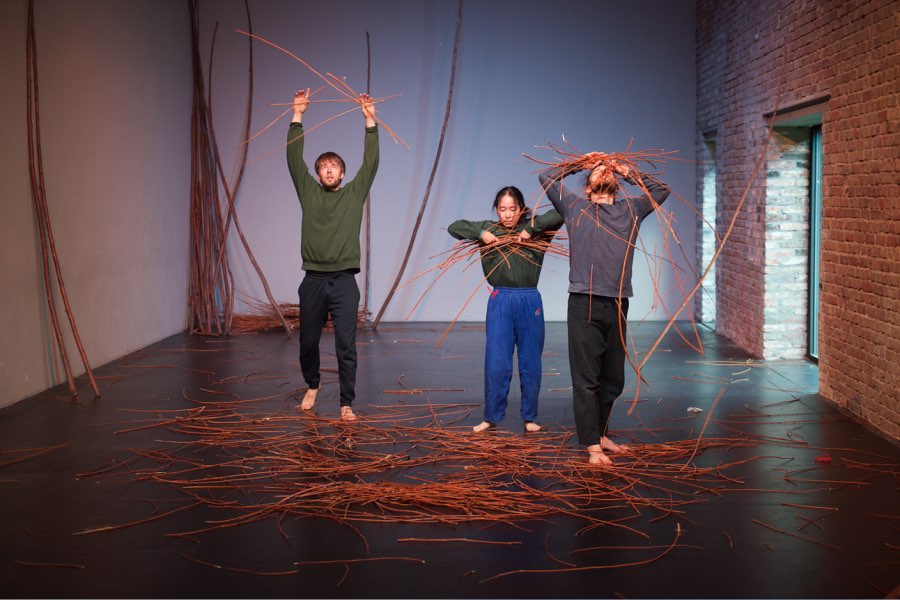
Isabelle, you have a special fondness for materials. Since Unturtled #1 (2010), you have been working with wide garments and long webs of fabric. You used beanbags for ‘Der Bau – Gruppe’ (2014), of which there are now also two children’s adaptations. In "Harvest", your first production for young audiences, the performers dance with willow branches. How did it come about?
I was looking for a natural material to recycle and work with sustainably. So after something that stays alive in a way. When we cut down the large pasture in the garden of Wiesenburg, it was fascinating. A beautiful proportionality arises on its own: how many long large branches there are and how many medium length branches are formed, which are more whip-like and flexible, and how many small branches remain. Quantity ratios were ‘pre-structured’ by nature. We then sorted everything by size and bundled it like a harvest. All this handling of the material, dealing with it, taking your time, that was an important factor in the work.
What influence did the willow material have on your movements or which movements did you find in order to be able to dance with this new material for you?
Often it was about how to transport these bundles, how to grab them. What sounds they make and how flexible they are. The properties of the branches change over time. They become drier and more brittle or even more flexible when you put them in the rain. I work well in advance with research, without pressure, so that I can follow such processes.
The willow branches are sometimes quite long. To what extent are you dealing with it and how do you cope with it while dancing?
The longest willow branches fit straight into the width of the Tanzhalle Wiesenburg, so they are six meters long. The joint movement with the branches is much about shifting weight and feeling where your own center of gravity is in the body, then bringing the center of gravity under or behind the hand when grasping. If you place them well, the balance is right. We did aikido stick training regularly during this time. And that has contributed a lot to understanding how to deal with the pastures.
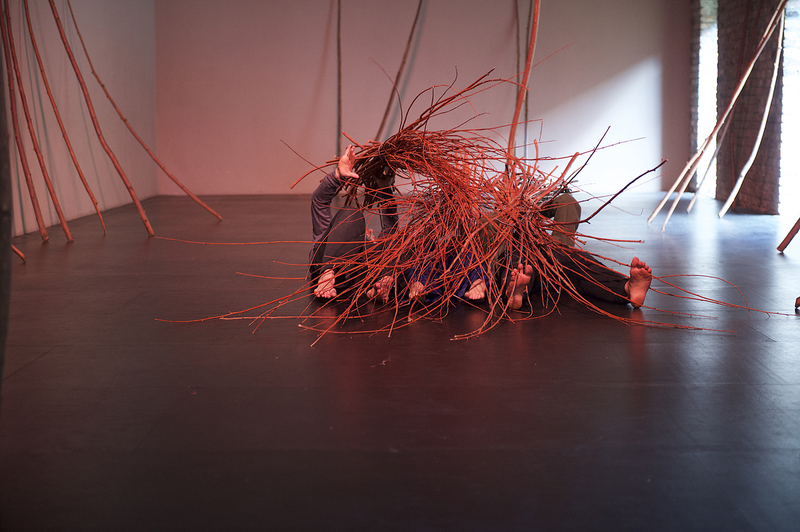
Harvest © Dieter Hartwig
In a recent essay you wrote, you mention that you don't think of constant production and recreation while working. This is also supported by the fact that you like to repeat movement sequences in your pieces, such as in ‘Turning Solo’ and ‘Double Portrait’ (2017). Over the years, have you found a kind of work philosophy for yourself and how would you describe it?
I definitely have something that is methodical and runs through the years. This includes continuity in the training approach and movement theory, which is influenced by somatic practices and my daily Aikido training. The other axis is the question of how something is made visible: how does it not simply get lost in space or in dance processes, but how does something become sculptural in space in a very precise way – in a natural way, by observing movement processes. It is less about a concrete, willful looking than about a holistic and intuitive, which you can classify into your own recognition and which allows you to discover new things again and again. I definitely have something that is methodical and runs through the years. This includes continuity in the training approach and movement theory, which is influenced by somatic practices and my daily Aikido training. The other axis is the question of how something is made visible: how does it not simply get lost in space or in dance processes, but how does something become sculptural in space in a very precise way – in a natural way, by observing movement processes. It is less about a concrete, willful looking than about a holistic and intuitive, which you can classify into your own recognition and which allows you to discover new things again and again. I definitely have something that is methodical and runs through the years. This includes continuity in the training approach and movement theory, which is influenced by somatic practices and my daily Aikido training. The other axis is the question of how something is made visible: how does it not simply get lost in space or in dance processes, but how does something become sculptural in space in a very precise way – in a natural way, by observing movement processes. It is less about a concrete, willful looking than about a holistic and intuitive, which you can classify into your own recognition and which allows you to discover new things again and again.
In your work, you refrain from typical direct interaction between performers and spectators, as you know it from children's theatre, for young audiences. What interests you when you're choreographing for children?
We don't talk to the kids directly, that's right. On the other hand, it was already a topic for us to work with eyes and to see what it is like to reflect on the children. Probably, a child's audience is about not approaching it selectively, but staying with them and perceiving the space and the children as a whole.
It's a lot of work on your own expectations. Everything is equally important for young children. If they run and play during the performance and then return, it doesn't mean that what happens on stage is boring. You have to deal with that first. Because we are not used to this from adult spectators
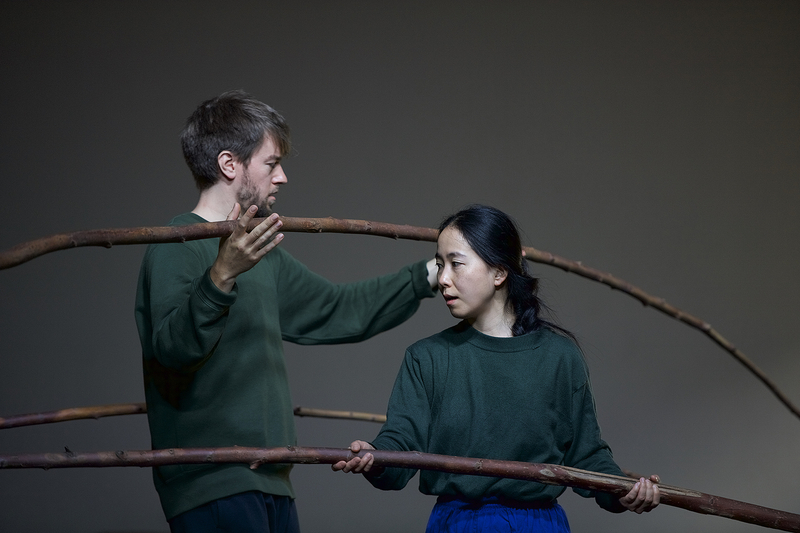
Harvest © Dieter Hartwig
Do you approach a piece differently when you are choreographing for children?
It was very important to me not to explicitly do something for children. Which is not easy, because it is a commissioned work for children from three years. It was a permanent controversy. I have watched over and over again where I focus too much on the children. You like to do something didactic or approach the whole thing too heady, just too wanted. I try to have the kids on the screen, but I don't narrow down too much.
In your group pieces, all dancers remain individuals. Even if they perform the same movements, there is always something personal shimmering through them – without their faces being particularly present or you coming up with characters here. They are experienced in their entirety, as a whole body and out of a certain natural restraint.
That is exactly the point. I want everyone to be as much as possible about working on the movement, he or she can be himself or herself, and also be with himself or herself. I have a relatively allergic reaction to playing on things or ‘putting something on’. When someone rejoices, a smile or laugh comes out of an inner impulse or a funny situation. Authenticity as something anchored in the movement plays an important role for me. It is important to me not to do anything for the outside and for the form. That's why I always try to find the processes quite quickly at the beginning of the process in order to be able to work long enough and multi-layered. Because the more these are out of the mind, because they have often been passed through and automated, the more each individual has the opportunity to be in doing and being and to leave the form.
The dancer and choreographer Isabelle Schad first studied ballet at the John Cranko School in Stuttgart. After six years in classical ensembles, she moved to contemporary companies, including Brussels to Wim Vandekeybus. From 1999 she initiated her own projects. At the center of her work are the body in its materiality, process and experientiality, but also the relationship between body, choreographer and (re-)presentation as well as the topics of community building and political engagement.
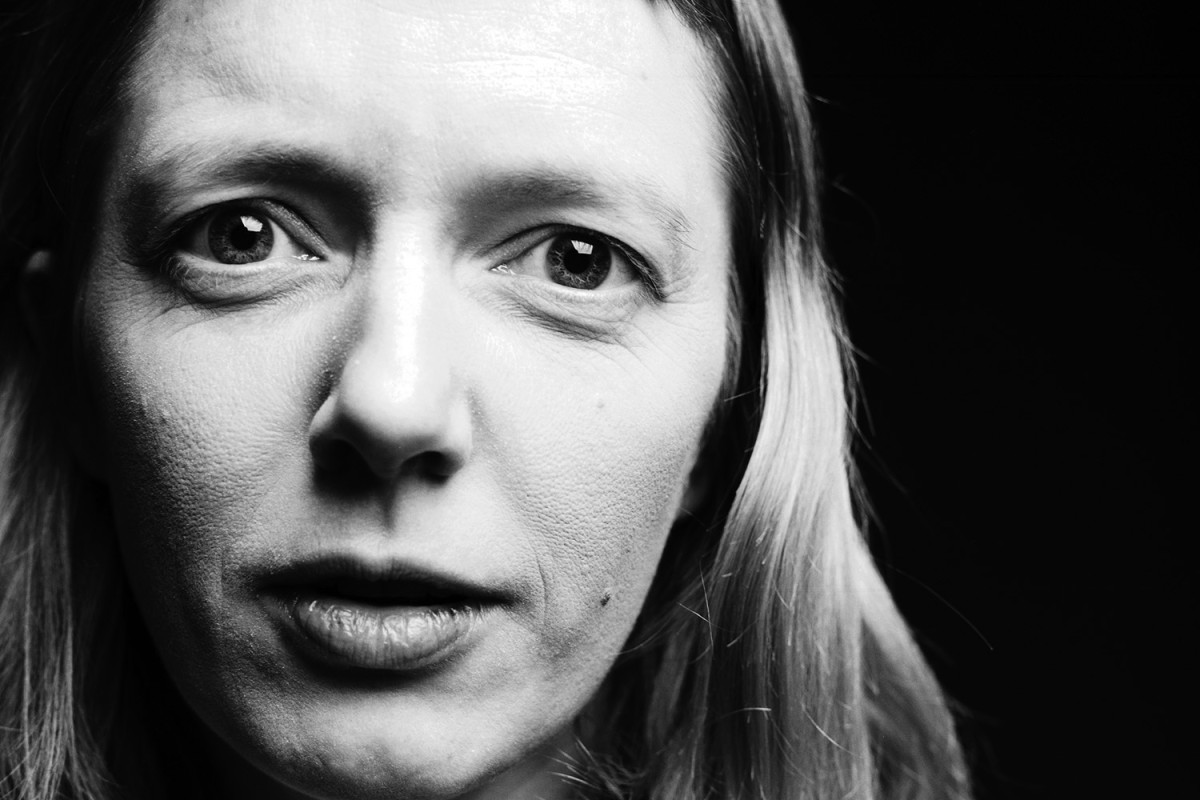
Isabelle Schad