Elisabeth Leopold
fragile
Contribution to the dance piece
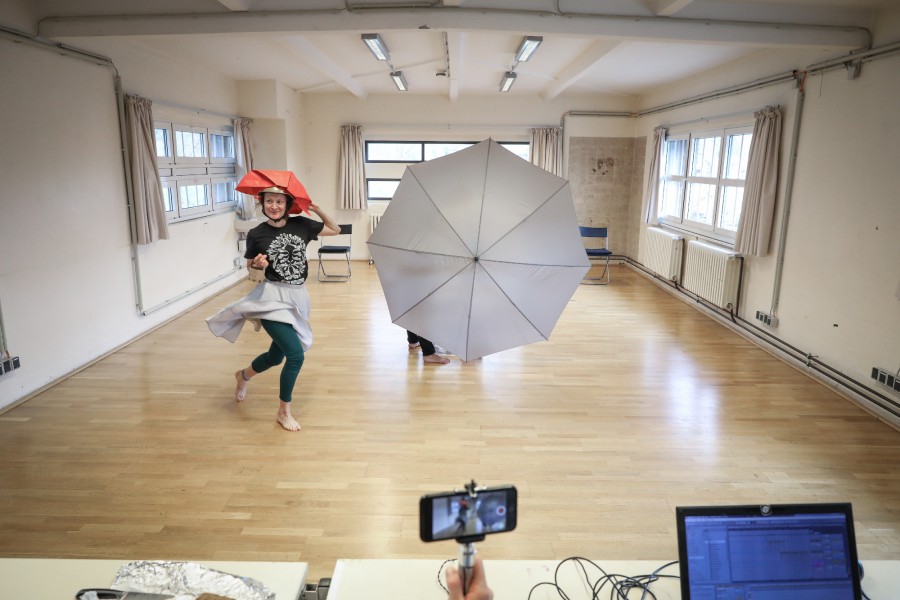
Strengthened fragilely.
A report on the current production by choreographer Clébio Oliveira for spectators aged three and over. In cooperation with Theater o.N. and Offensive Tanz für junges Audience.
Already in October 2019, the Brazilian choreographer and dancer Clébio Oliveira began the research process for his piece fragile and conducted a workshop with the entire ensemble and then a first daycare visit. This spring, the team started the rehearsal process until two weeks before the premiere in March 2020, the contact barrier due to the corona pandemic came into force.
As the title suggests, fragility is about human vulnerability, fragility and fragility, especially in phases of childhood and old age. With a focus on these phases of life and on particularly affected persons, places such as children's homes or retirement homes and their connection to feelings of loneliness, abandonment, or the loss of loved ones came into the focus of the discussion and thus the creation of pieces. Imaginations of these feelings and situations gradually mixed with the childhood images of personal experiences of the performers Olga Ramirez Oferil and Michaela Millar and formed the foundation for a poetically implemented, mental as well as physical memory on stage.
Loneliness is one of the greatest dangers in our human development and the absence of touch and contact has immense effects on our psyche. Especially in the current situation, in which our everyday lives are increasingly retreating into our own homes and social distancing is becoming a state requirement on the one hand, but also a self-responsible solidarity action on the other hand, this topic and thus also the vulnerability of our society moves into the immediate present. This also became clear in the written exchange with the choreographer and the performers, where fragility apart from the thematic focus was from the beginning a constant companion of the entire process. On the one hand, the current situation, on the other hand, the illness of a formerly planned performer made feelings of loneliness and fragility more tangible and personal.
Such personal connections played an important role in the process of remembering and invoking childhood experiences. How do you remember yourself and make memories of others your own? What childhood images do you have in your memory?
Olga Ramirez Oferil explains it as a “return at this time, when our still flexible character is influenced by what is happening in our environment. Smells that transport us at a moment's notice, like old pictures in black and white. Places that may no longer be visited or that no longer exist as they did then. Important people who are no longer there. The further the distance, the more nostalgic the journey can be.”
Based on the above-mentioned mental sketches, these journeys of remembrance were stimulated through images, feelings and objects and led more and more in the further course of the rehearsal to an own body language of living through, which finds its place of expression on the stage. How does the body remember? Michaela Millar raises the question of how childhood experiences are expressed when they are lived through with an older, altered, perhaps more limited body?
Almost independently, the fictitious figures for the play developed from this research. The two performers become complementary characters on stage, whose visions continue in each other and where one becomes part of the memory of the other.
“Research work transcends our personal universe, imagination, creativity and it transforms in some way in actions, gestures, movements. Thought itself is already the beginning of movement in space.’ Clébio Oliveira
The forced interruption at the end of the rehearsal process had a frustrating moment, because it was precisely at this time that the encounters with young spectators were planned and the dialogue with the audience was to begin. The children's perception can only be considered to a limited extent, but above all through a very associative approach and through body language, Clébio Oliveira docks with imaginary worlds of children and adults alike. To whom the worlds of remembrance belong dissolves, becomes something divided and collective on stage.
From these dreamlike, imaginative journeys, the merging of the figures, the physical relationships to objects and together with the musical accompaniment of the musician and composer Matresanch, a very playful, atmospheric mood emerges, which should allow children many associative points of contact.
Due to the many parallels and present themes that fragility negotiates, it is all the more regrettable not to be able to experience the play live in its topicality. But it will also enrich us in the future. On an early opening of the halls!
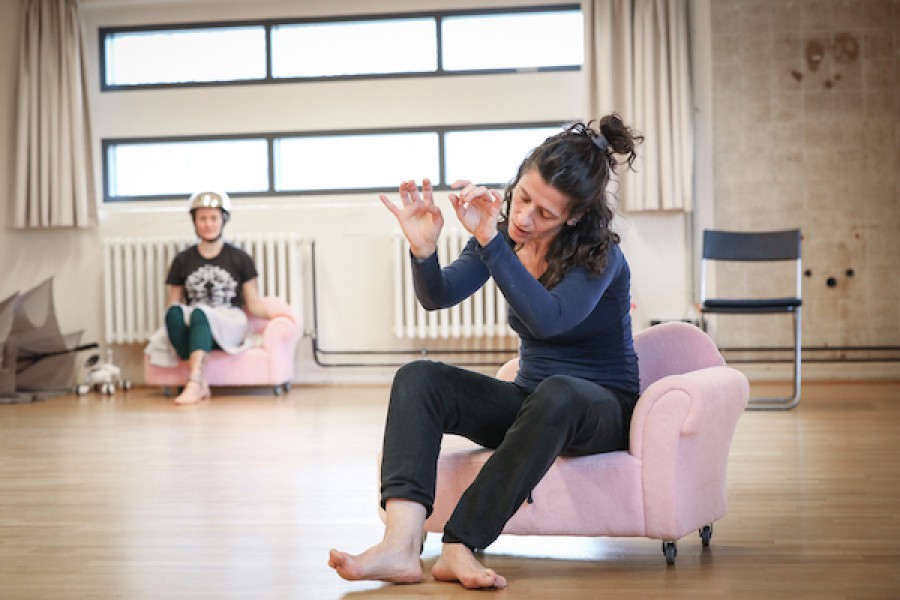
Fragil sample © Sebastian Runge