Dance Ambassadors Mira and Etchi
"...experience that sense of freedom."
Interview with Farah Deeh and Olivia Mitterhuemer from Potpourri Dance
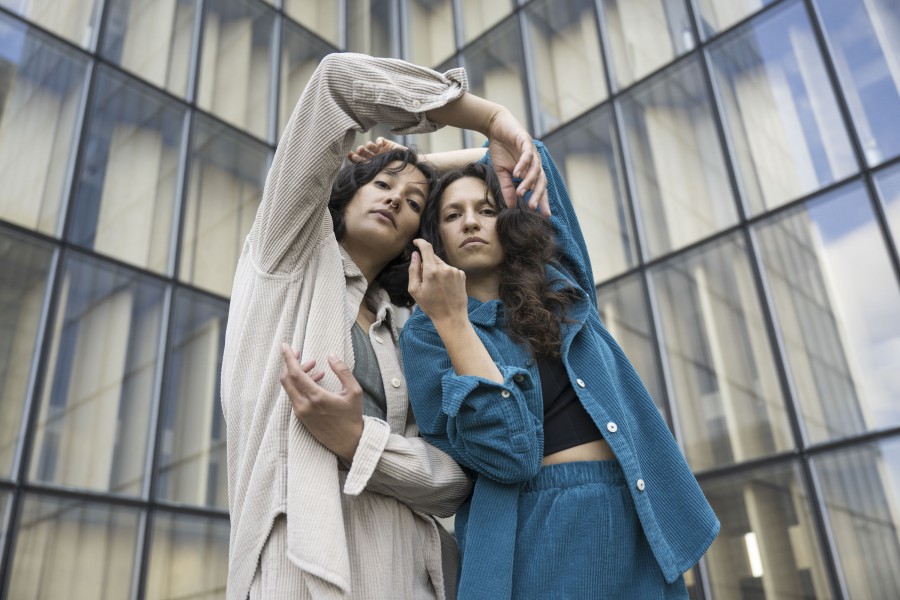
The performance PUSH by Farah Deeh and Olivia Mitterhuemer from Potpourri Dance was created as part of the RAUSGEHEN project in autumn 2023 in cooperation with the Hector Peterson School.
Olivia and Farah have been dancing ‘House’ together since their youth and are known not only in their places of residence in Vienna and Salzburg, but also through successful tours in many other places. In autumn 2023, as part of the RAUSGEHEN project of Offensive Tanz für junges Audience at the Hector Peterson School Berlin, they gave several dance workshops for school classes and were inspired by the work with the young people who developed House Dance Performance PUSH. The piece was premiered on 14.11.23 as part of the Offensive Fachtag Equity im Tanz an der Schule.
The workshops were very well received by the students, and many hope that Olivia and Farah will start such a project again next time they are in Berlin.
With phrases like ‘the workshop was great and a lot of fun!’, pupils described what they had experienced. They had a lot of fun with the dancebattle-like atmosphere that arose when Olivia and Farah presented some dance units to the classes in the middle of a sitting circle. In fact, at the end of the ‘Equity im Tanz’ day, there was also a real dance battle in the school gym, where Olivia was part of the jury. Previously, however, the performance PUSH by Olivia and Farah took place, during whose rehearsal we were already allowed to watch in the gym.
“For me, the most important thing about dancing is that I always reach this flow state, so when dancing doesn't just feel like work and I have those spiritual moments every now and then. And the fire is kind of burning.”
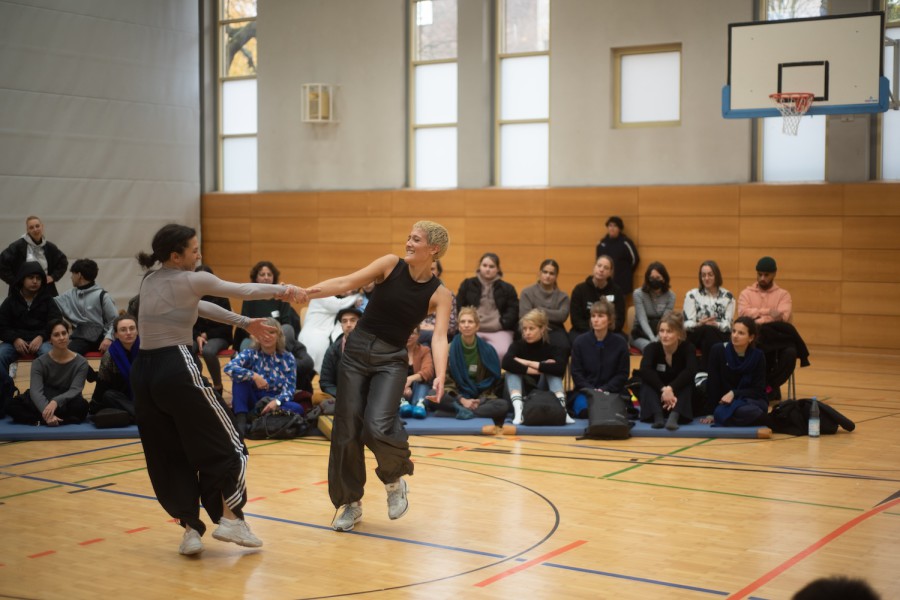
Push © Miriam Tamayo
Then we asked the two of them a little:
How did you come up with ‘House’ and what do you particularly like about it?
House Dance is a dance style that we got to know 15 years ago, in a studio in Salzburg. Since then we have been at home in house dance, but also in hip hop, locking, popping, simply in different street and club styles. We have started to dance shows ourselves and are also a lot in theaters with our dance repertoire. We also organize dance battles and are active as battle dancers ourselves. During several research trips to America and Asia, we learned more about this dance culture, which has developed in many places.
House Dance originated in America - late 70s, early 80s - in clubs: It does not come from the street, as many people believe. House has been shaped primarily by marginalized groups, by a queer community. We deal a lot with the origins and development of the dance style and where house dance is located today.
Which place did you like best on your tours?
Difficult question. We were once in New York, in pairs, on a research trip where we just went a lot to clubs, parties and the dance studio, we just totally immersed ourselves in the house culture. And just look: What is it really like in New York? What is it like in America, where house dance came into being?
It's also very exciting in Paris - we were there last year. We created a piece there and realized that the club culture is completely different again. As well as generally stop the culture and population there. On site, there were also other factors that shaped and made possible the club culture. In addition, the house dance scene is simply much larger than in Austria.
So Paris and New York are definitely the house dance and music metropolises you should have been to.
We are always fascinated by the fact that people have felt so comfortable in this style and these clubs. Because they found their families there and were able to live out this feeling of freedom.
© Nora Haakh
What does dance mean to you?
Dancing is simply an outlet to break out of everyday life, to dance your head free, to solve various problems. For example, the feeling of being under pressure, which we also treat in the performance PUSH.
And it's just mostly (not always natural) a very nice feeling to feel your own body and express yourself with the body. Not with words, but with your own body. In addition, house dance as a dance style is very strongly bound to the music, with other dance styles this is perhaps less the case. But House lives full of this very bass-heavy, strong music. And it's just nice to express yourself to be driven by the music.
So would you say ‘house’ is a dance style that could not exist without music?
You can dance the style even without house music, but basically both belong together. The origin of the dance style is the house music of the clubs.
Now we are going out of the clubs, into the studios or on the theater stages. But without house music, you take away an important element from the style. I don't know if I would call it House Dance.
Would you describe your dance as a kind of ‘alternative to words’?
Yes, definitely. And the language I've learned in recent years is house dance and hip hop.
How come you dance in duet? What is so special about it for you?
So we met at 12-13 years old in a hip hop class, and then started dancing championships relatively early with a group of girls. At some point we were - with various ups and downs - only two.
Now we have our club, which we founded in 2006. We also organized a battle and grew together a lot. Both professionally and amicably, we have experienced a lot together. Through many experiences, we have always (also full-time) stayed with it, and that as a duo, which does not happen so often.
What were your dream jobs as a child?
When I look at my friendship books from before, it says: ‘Flower picker’. I always wanted to be a psychologist.
And have you always liked to dance?
So I think I've been dancing since I can walk - there are a lot of videos of me as a child where I dance. And then I attended the first course at the age of six at the Volkshochschule.
Funnily enough, we both said in an interview at the age of 18 that we never wanted to become full-time dancers, because then it would be work and not so much fun anymore. That's why this fun factor is so important to us.
What was the most glaring reaction you've ever had to a dance piece?
I once did a solo piece with a company about my Muslim and Christian roots. There I was veiled on stage and then also revealed and have revealed dancing on a carpet. Subsequently, a person from the audience came to me and was completely excited that this could not be done at all. This was the fiercest reaction that comes to mind and shows what art can trigger.
On the other hand, there were also people who looked at a piece again and again and cried every time because it touched them so much.
What experience have you had here at the Hector Peterson School?
It was very cool. In total, we conducted workshops with at least six different classes. After the dance workshops, we exchanged ideas with the students. With the themes that came up there, we then started to create a piece. For samples in front of other classes, we then received direct feedback on the piece development. This was a very special process because we have never received so much feedback immediately before and also so much honest, unfiltered feedback from students who do not go to the theater every day now. It was also a sense of success that many pupils, in whom the teachers had predicted that they often did not work so much in class, then got out of their way at the dance rounds, made very active contributions and were fully absorbed. That was nice.
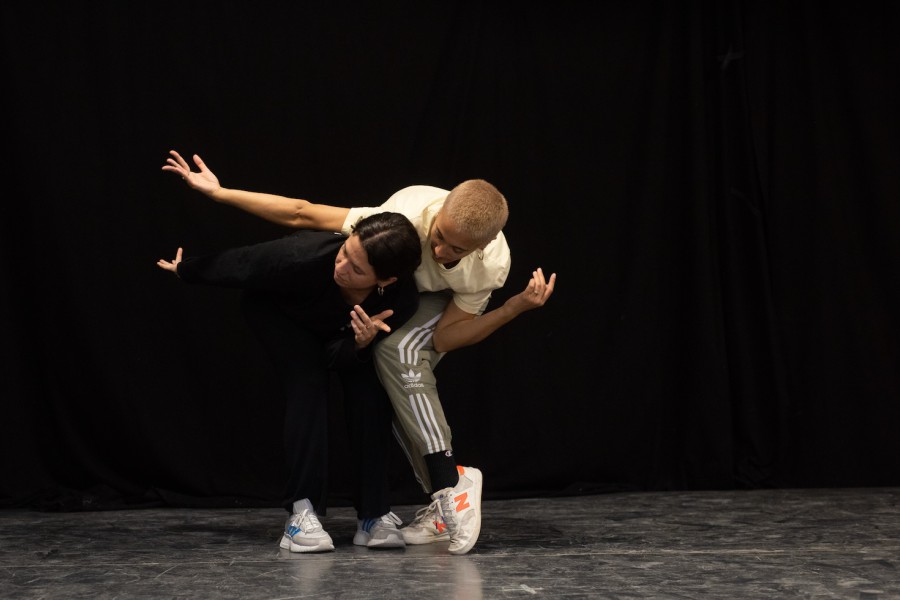
Push © Miriam Tamayo
Are you very excited before you show up?
Yes, but normally you are also very happy and a bit of lamp fever is simply important. Otherwise it would be boring at some point.
A little thrill is always there when you step on stage. One is then fully occupied with his own body and also speaks from his soul somehow, which of course is always an overcoming.
What do you do when you get a blackout on stage?
This happens every now and then. But just keep going, we've learned this over and over again at the show championships: Just pretend it is planned. We always remember that the audience doesn't really know what we want to do.
Is it hard to make money dancing?
So we're doing well, but you have to stay on top of it all the time and generate new jobs that usually don't just fly to you like that. You have to work hard for it, but I don't think we can complain. We live well from it and are satisfied.
But sometimes you have several projects at the same time and then sometimes none at all. It's always an up and down. You have to get used to it if you want to work independently as a dancer. But you notice: The more you put in, the more will come back at some point.
Thanks for the interview Olivia and Farah!