Tim Winter
On the go to the division?
A review of the "FUTUR TANZ I" symposium
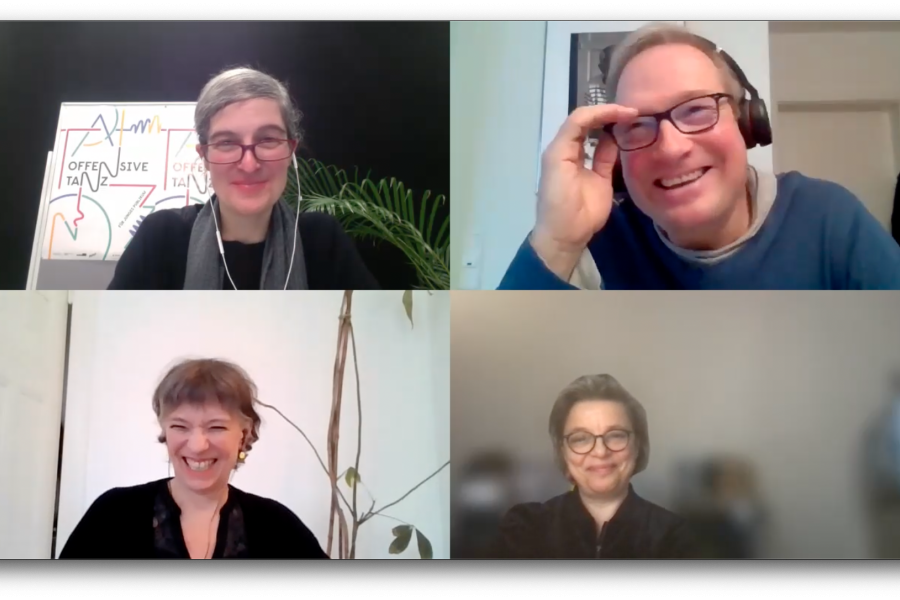
To the symposium FUTUR TANZ I: On the move to the sector, dance and theatre experts met on 23 January 2022 to discuss the future of ‘dance for young audiences’: Where do we situate ourselves as actors in this art form? How do we want to work together in the future? And who are we?
With more than 120 registrations from all over Germany – from large and small theatre and dance institutions, the independent scene to sponsors of cultural policy – it became clear in advance that there is a great interest in these questions and a high need for exchange. More than 60 participants finally followed the digital conference, which consisted of three blocks of debate and a discourse format in small groups (breakout rooms).
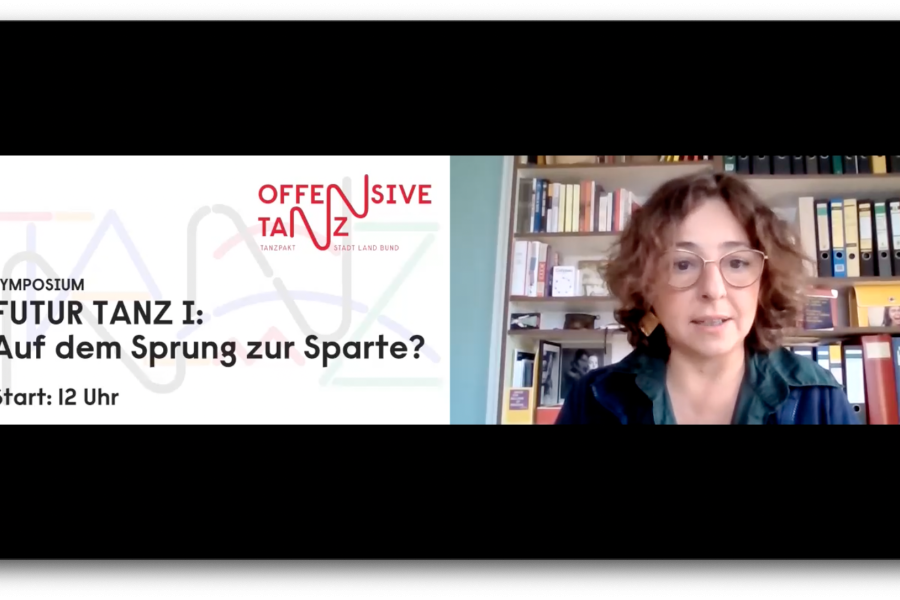
Livia Patrizi, Artistic Director of OfTa partner TANZKOMPLIZEN, opened the event with the plea not to lose sight of the young target group and their needs in all structural considerations:
“When young people don’t go to the theatre to watch dance, it has something to do with our cultural system, that is, with us.”
We as cultural professionals are responsible for removing barriers to access in order to make dance attractive to young audiences for children and young people: "What can we do to strengthen dance for young audiences sustainably and nationwide? Fight against adultism (...) and ensure that this term is taken seriously and represented alongside racism, classicism, abelism, etc. in the current specialist discourse? Fighting for all venues, theaters, dance houses, festivals, independent companies and thus the entire dance scene to offer program for a young audience? That in the future all juries of funding programmes will always include experts for young dance?’
Moderator Elena Philipp passed on these questions to the guests of the three debates.
Where does the dance stand for young audiences today?
In debate one, the focus was initially on the location of the division between dance and children's and youth theatre. Stefan Fischer-Fels, director of the Junges Schauspiel at the Düsseldorfer Schauspielhaus, took a look back into the 1970s. The development of a separate section of children's and youth theatre was already driven by the same core topics that are still relevant today: the right of children to cultural participation, the question of the definition of the art form or the audience, the goal of obtaining higher budgets and better working conditions for the children's and youth sector, the claim to recognize the realities of the children's lives and not to reduce them. According to Fischer-Fels, establishing children's and youth theatre as an independent division helped to strengthen children's rights in general and was able to achieve a lot over the years. But to this day, there are great differences to the working and budget conditions in adult theater. A separate division is therefore helpful, but not the solution to all problems.
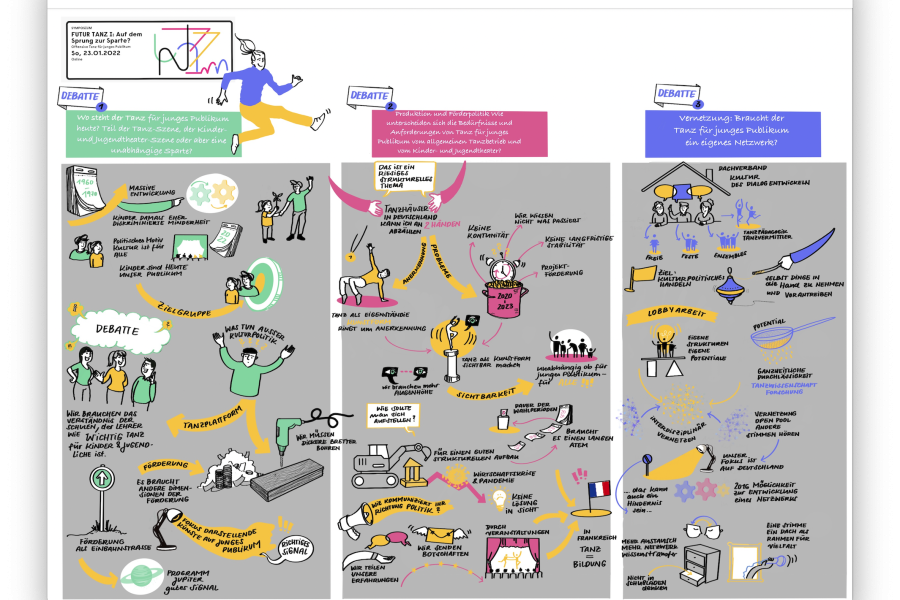
Martina Kessel, CEO of Aktion Tanz, ties in with her experience as founder of the Junger Tanz division at Tanzhaus NRW: Makers, producers and not least the venues themselves are still faced with special challenges if they want to bring dance to the stage for young audiences. Many other countries, especially Belgium, the Netherlands and Scandinavia, are already much further in their structures. There, the demand for high-quality, participatory cultural offerings for children and adolescents is estimated to be higher than in Germany. 2006 is a take-off: Young dance has for the first time been made possible a long-term structural promotion of the field of dance for young audiences. Thus, the first cooperations within the scene could be developed, the cooperation with educational institutions strengthened and reliability and quality in the daily work for young audiences maintained. Behind all these factors is the need for continuously designed financing and sufficient spatial equipment.
Gabi dan Droste, director of the FELD Theater and initiator of the Young Dance Network, focused on the dance creators themselves. Young artists in particular are often interdisciplinary, as they no longer see themselves only as dancers, but at the same time as bloggers and musicians, media professionals and discourse participants. This makes contemporary dance an interdisciplinary art form of its own accord. With a view to the theatre world, dan Droste addressed the long-sleepy integration of the art form dance into institutional structures. And concluded, similarly to her previous speaker, with a plea for quality assurance and sustainability, in order to make the leap into a possible branch of dance for young audiences a ‘flight’ and not a ‘fraction landing’.
The search for differences and similarities between theatre and dance shaped the subsequent discussion of the three speakers: Intensive text and manuscript work on the one hand, work originating from an idea or improvisation on the other. State resources for months or even years of piece development are faced with often narrow project financing and short rehearsal phases. Do you need a quota for dance? A quota for children and youth productions? There was agreement, especially on the findings: In development and work processes, such as the early participation of young people in piece development, everyone can learn from each other.
Continuous support for structures
After a brief movement impulse from Florian Bilbao, debate two focused on production and promotion policy.
Kerstin Evert, head of the K3 in Hamburg and member of the network Explore Dance, stated that there are still many structural tasks to be solved for the art form dance: Dance is more often than other divisions threatened by deletions at city and state theaters, dance juries continue to be uncommon. Despite the differences that exist between dance for young audiences and the general dance business, both areas share the same goals: larger funding volumes and more intensive communal work. Continuity is the most important setting screw here, both for the production and placement, as well as the daily work and employment operation.
With a view to the long promotional tradition that dance would have at the Bundeskulturstiftung, Theresa Darian opened her contribution. With the Jupiter program, the target group of young audiences has now also come into focus. The main reason for this was the recognition that in the field of children's and youth culture at theatres, there were often only very limited funds available for training, fees and production work. However, a foundation alone cannot remedy these structural shortcomings. Intensive, interdisciplinary discourses are still important here.
In the ensuing discussion, it was raised on several occasions that start-up financing – such as the current restart funds – would only be sustainable if structural follow-up subsidies followed. Otherwise, as has happened several times in the past, resources will flow into the repeated construction of structures that cannot then be maintained.
Does the dance need its own network for young audiences?
The topic of networking was then discussed by Michael Freundt from the Dachverband Tanz and choreographer Alfredo Zinola. Building a culture of dialogue was one of the first tasks after the founding of the umbrella organisation Tanz, says Freundt. In addition to lobbying at the federal level, the insight has grown not only to finance concepts, but also to implement them themselves in order to develop expertise and enable basic research. He also stressed the importance of interdisciplinarity or permeability in dance – between professional and semi-professional artists, as well as in questions of the conquest of theatre structures by dance, in order to exchange one's own potential on an equal footing.
Alfredo Zinola cited his employment as a factory artist at the Tanzhaus NRW as a good example of at least two years of financing as a choreographer. The exchange of knowledge, which he considered to be too low within the dance sector, was one of the main objectives when establishing the ‘Young Dance Network’, an initiative within ASSITEJ International. Dance should not retreat too much into its own division in order to generate sufficient visibility. This also requires funding programmes at the international level that facilitate transnational exchange between artists.
In four breakout rooms, all symposium participants discussed the questions formulated in advance in small groups. The desire for a closer exchange between established institutions and the independent scene was discussed, for example through the occupation of the management levels at theatres and dance houses. In addition, the desire for an independent network of dance for young audiences, which ideally functions without too strict a distinction from other art forms, as well as the need for more knowledge transfer, a joint struggle for more participation of young people in cultural life and the understanding of theatre as a place for all forms of art.
The symposium FUTUR TANZ I was a first step in leading the still young art form dance into the future for young audiences. Following up on the questions of location and thinking further, the second edition of FUTUR TANZ will take place on 15 May 2022, then as part of the FRATZ Festival von Theater o.N.