Christine Matschke
Creating alliances on an equal footing
Report on the second symposium
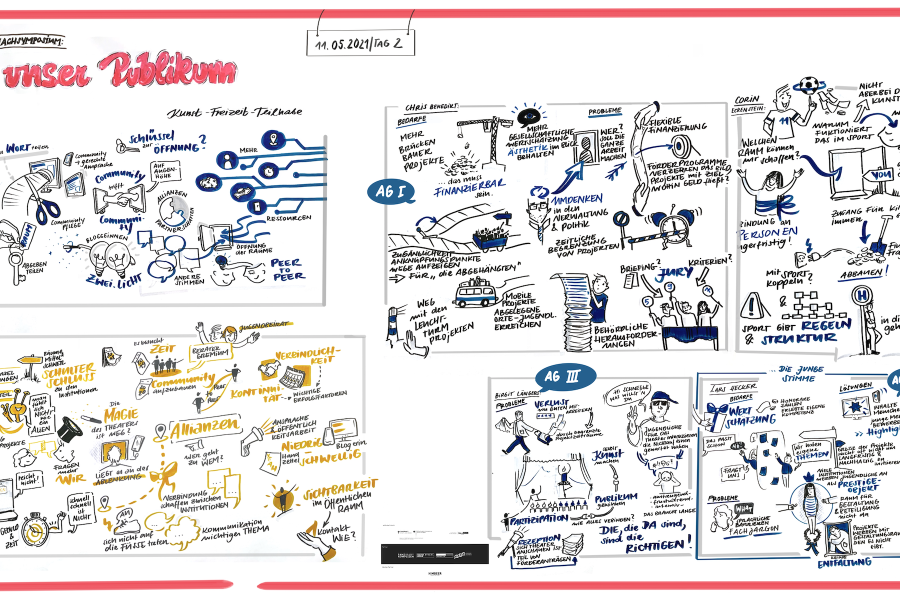
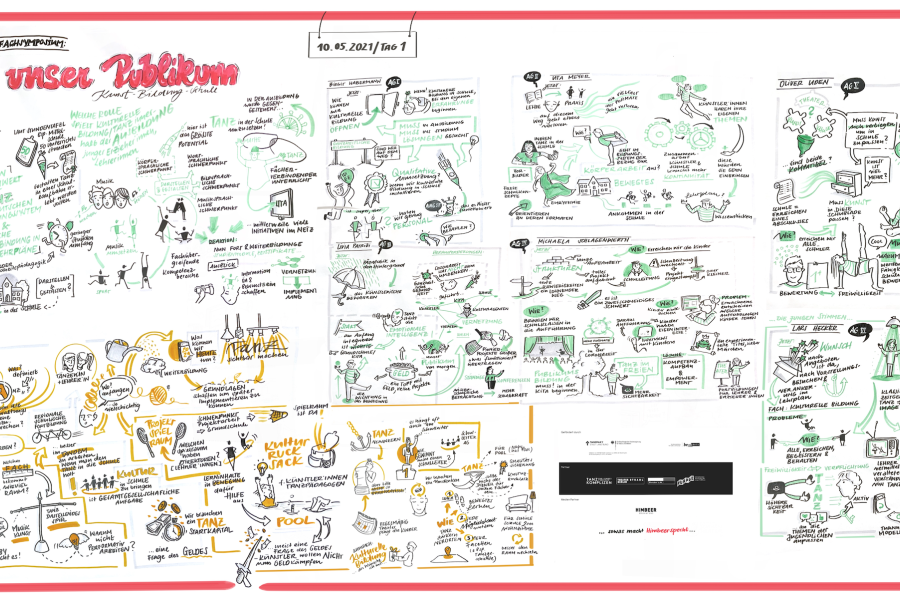
In May 2021, our three-day symposium on ‘Who is our audience?’ took place. Numerous experts from the fields of (performative) art, culture and media were involved, who together explored the question of which channels and means can best reach a young audience today. Involved were also several young people who followed the contributions of the experts and with their opinion in the end made a critical reflection possible. Freelance dance journalist Christine Matschke summarized the results for Offensive Tanz. Graphic designer Liane S. Hoder also turned the results of the three days into vivid and informative illustrations. The text reproduced here is only excerpts, the long version can be downloaded at the end of the article together with further documentation material.
Cultural education can help children and young people to live successful lives (in both their personal and social dimensions), especially in the context of the coronavirus pandemic. It supports skills that are important for a return to social (school) life and teaches that learning can also work differently and without pressure. But how do you reach children and young people in the first place? How do you win them for the arts and other approaches to the world? And how can existing strategies of different institutions of cultural education be shared, transferred and sustainably developed together? Building on the results of the Audience Survey 2020 (see download area below), Offensive Tanz für junges Audience focused on these questions under three main topics.
Structurally anchoring (dance) art?
Day 1: Arts - Education - School
In the question of how children and young people come into contact with the performing arts and dance in particular, educators and teachers play a decisive role. Visits to the theater and the program selection are often characterized by their individual motivation and preferences. In addition to parents and multipliers of the same age (so-called peers), they are therefore pioneers and door openers for cultural and thus also social participation.
Where the dance hides (in the curriculum)
Claudia Steinberg, professor of dance and movement culture and head of the institute of the same name at the DSHS Cologne, shed light on realities, obstacles and needs in the integration of dance in school and early childhood education in her keynote speech. As an essential result, Steinberg pointed out that dance is particularly reflected in cross-sectional topics of the so-called aesthetic subjects. These have a special position in the education system, their objects (movement, music, etc.) require special framework conditions and mediation settings.
Implement dance – make gaps, models, ideas transparent
As it turned out in the course of the discussions, the importance of dance in society is still too low, also in comparison to all other non-performing arts. In contrast to music and visual arts, for example, there is a clear lack of a lobby here. The anchoring of dance in school therefore requires an equal view of all disciplines of the performing arts, says Uta Meyer, project manager at explore dance. Against this background, the question also arose as to how easy it was to achieve something for the dance via the administration. Oliver Uden, specialist speaker for the subject "Theater/Darstellendes Spiel" in the Berlin Senate Department for Education, Youth and Family, referred to the so-called Uniform Examination Requirements (SPE), on which all Abitur examinations in the subject "Darstellendes Spiel" are regulated nationwide in the Conference of Ministers of Education and Cultural Affairs. There would be an explicit indication that performative work is to be done. The aspect of ‘self-experience’ was also mentioned as essential in the context of a desired, stronger implementation of dance in the field of cultural education. The own experience of dance was considered important not only for already practising teachers and school leaders, but also for teacher candidates. A difficulty here as well: the lack of recognition of dance compared to other art disciplines, as well as stable funding opportunities and successful continuous ‘systematic cooperation’ (between schools and cultural institutions).
A problem within the school-arts relationship drew the attention of young people to the ‘young voice’, picking up on one aspect missing from the discussion: In general, school and art are understood as a pair of opposites. In their combination, they are associated with terms such as ‘mandatory’ and ‘voluntary’. In other words: Should dance, if intended as a school subject, be evaluated? Or should it exist as a grading-free, complementary offer to schools?
Making cultural education strategies sustainable
Day 2: Arts – Leisure – Participation
Cultural education takes place not only in schools, but also in the leisure activities of children, young people and families. But how do you reach them in their private environment? And how can real participation, equal opportunities and diversity be made possible?
High culture and grassroots movement
At the beginning of the second day, the question was whether large institutions had better starting conditions than smaller initiatives in terms of accessibility. The relationship between ‘large’ and ‘small’ institutions is particularly problematic when it comes to entrenched views of each other. Katja Frei, Head of Education & Outreach at the Berliner Philharmoniker, reported on her experiences in this regard. Thus, she had often experienced that larger institutions questioned themselves much more, but were still more denounced than smaller ones, who often only wanted to continue their best practices. There is a lack of productive exchange on both sides. The prerequisite for such a successful cooperation is commitment.
Ignite dialogues instead of sending messages
In order to provide children and young people with successful access to cultural education, existing hierarchies and power relations must be dissolved. This requires time (in the sense of continuity) and space (in the sense of self-determined participation). In practice, this means: "Children should be given as many opportunities as possible to be determinants and to be involved in all positions of artistic production", says Corinne Eckenstein, Artistic Director at the Jungle of Vienna – true to the motto: Not doing something for children, but with children. Community work and a direct approach to the young target group are the be-all and end-all for this and, according to the discussion participants, works particularly well via peers, FSJlers, interns and other persons. These offer opportunities for children and young people to identify well with them through appropriate access or their proximity to the target group.
Culturally Binding Instead of Forming
According to Livia Patrizi, who attended the second day of the symposium as a guest, the performing arts venues for the young are therefore not only places of production, but always also places of cultural publicity, where different milieus come together. Patrizi therefore suggested referring to ‘places of cultural ties’ instead of ‘places of cultural education’. She emphasized the reciprocal relationship of such places to society and the potential therein to be able to withstand differences.
How to know! Using Off- and Online Potentials Equally
Day 3: Arts – Communication – Digital media
Public relations contribute significantly to reaching an audience. What are the opportunities and risks associated with the increasing involvement of digital and social media in this area of work? And through which online strategies do children, adolescents and young adults feel particularly well addressed?
Get Participation
Increasing digitization processes in all areas of life have not only been observed since Corona, but the pandemic has once again significantly pushed the shift to the digital space. Despite critical reservations, Gabi Dan Droste hoped for opportunities for new formats from this ‘turn in time’ and advocated active participation in such an uncertain transition phase. The artistic director of FELD – Theatre for Young Audiences believes that it is important to find a way of dealing with this and to remain flexible. An important point in this context: Not just to stream something, but to maintain the participatory work. Involving children and young people and giving space to their emotions has been indispensable in recent months, added Ciprian Marinescu, dramaturge at the Junge Tanzhaus NRW.
Digital media: Loss or gain?
According to Frank Schmid's experience, any communication via a particular medium already entails the limitation of the medium. The renowned dance critic and journalist also moderated the symposium program on the third day, asking whether content was lost through mediation via a particular medium. Marie Kube, spokeswoman and face of Jung and Artig – young friends of the Berlinische Galerie, saw no risk here. It is about accessibility and what kind of access to art you want to create – about hard facts or about impressions, appropriations and associations. For them, social media work is more an instrument of contemporary mediation work than a marketing tool. Judith Westphal, co-worker in Marketing & Communications with a focus on online at the Jewish Museum Berlin, added: Especially in the museum context, a rather playful mediation of complex content from different perspectives would have proven to be good. Continuous public relations is not about communicating everything that is possible. The information should remain ‘snackable’. Ultimately, all participants in the discussion agreed that, depending on the orientation of individual institutions, individual solutions must be found. There should be no either-or attitude towards off- and online strategies.
Downloads
- Long version of the report by Christine Matschke Allianzen Gestalten Auf Augenhoehe -
Results of the 2020 public survey