Dance Ambassador Celine
2 days among professionals
Céline was involved in the intergenerational exchange of experts on blurring borders
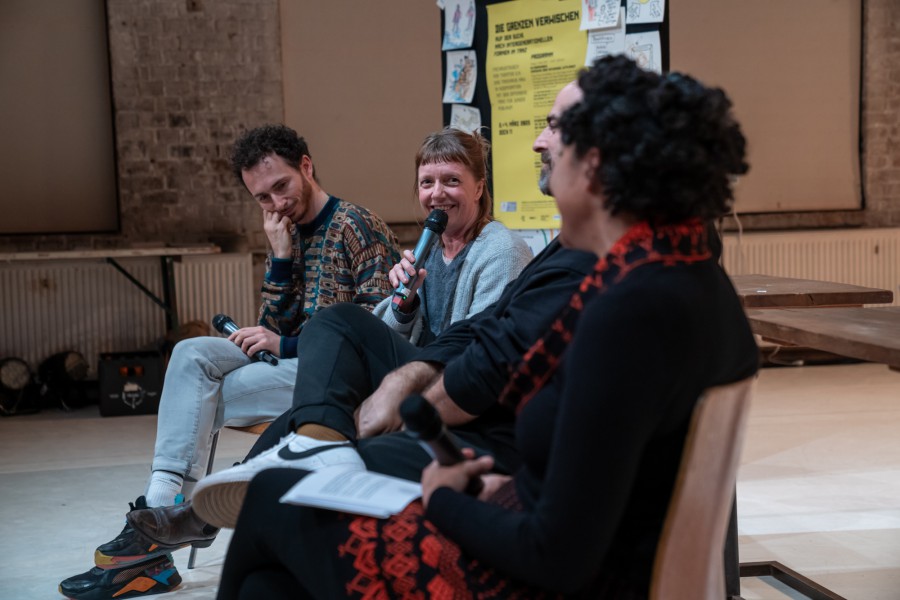
At the beginning of March, the technical exchange “The borders are blurring: In Search of Intergenerational Forms in Dance” by Theater o.N. Our dance ambassador Céline has mixed among the trade visitors and written down for us what she has experienced.
If you want to become a dance ambassador yourself, inquire about our call here.
2 days among professionals
2 days full of new impressions 2 days full of new ideas 2 days full of new solutions and 2 days full of suggestions and exchange
Surrounded by people from very different industries, I was allowed to immerse myself in a new world and just let myself drift. My pen and paper always in my hand, so that I could record everything directly with. A small sensory overload through all the different views, but still a very pleasant and relaxed atmosphere. I felt immediately welcome and was allowed to become a part of them. The chick, as they like to say, I was allowed to be. A young perspective surrounded by people who are already in the middle of the action.
It was an interesting journey for me. On the first day the heads were smiling over different questions and on the second day I was allowed to physically discover for myself what it means to blur the line between children and adults. The mix was great.
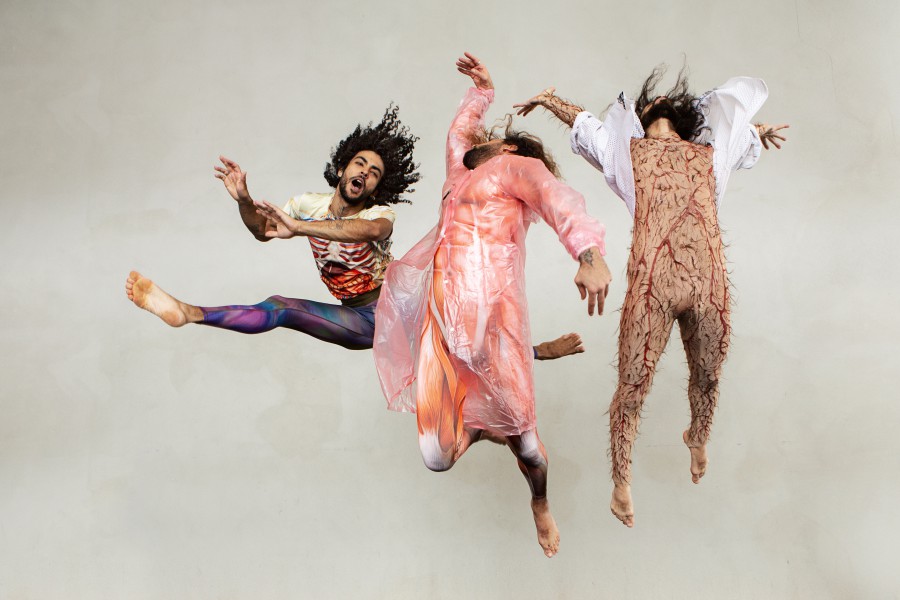
Air © Bernhard Musil
Day 1
Here the question was whether and how artists include the different ages in the artistic process. And what does it mean when we produce pieces for all ages? Do we abolish the genre of theatre/dance for young audiences when we have been ‘fighting’ for it for so long? To recognition, to resources, etc.
I could see how intensely everyone thought about it and it became clear that this topic is cross-sectoral. As separate as the scenes of theatre and dance seem, the more they are actually connected. The same questions and the same problems.
The word responsibility often fell in this 4-hour meeting. Who has the responsibility or to whom do we give up the responsibility? How do you design a piece so that the first taste flows and you feel like taking more bites? Creating trust in the process and in the work, so that you can also enter into a relationship of trust with the audience.
Three words that summed it up very well and that I noted directly are:
Dramaturgy of the auditorium
I think that explains itself and was perfectly formulated for me.
The theatre is also a meeting place. When I go to the theater, I want to have an experience and be emotionally touched. Children also want to collect their own experiences and experiences, but in some cases they are slowed down by external influences.
A theatre is a space of development. We adults use it for us. Why don't we give children the chance? We try to protect them or we want a visit to be perfect. But nothing is perfect and that's a good thing.
I observe this myself when I sit in a performance with many children that they have their own interpretations and feel and experience some situations differently. But I can draw so much from that. You don't go so heady into a performance. They go completely ‘empty’ into the performance, while we want to read through everything beforehand and want to know everything best beforehand. Why don't we just focus on the kids?
The exchange was very exciting and insightful for me. I was even asked if it was boring for me. All I can say is: 100% no. I was able to take so much with me and learn. I will also think about some points and make my own thoughts. A continuous process.
Day 2
The next day, at the workshop “Ich-du-du-Ich: Artistic work at eye level” with choreographer Alfredo Zinola, we danced together with parents and their children or as adults without children. We were allowed to become a child again and were invited to participate and observe.
For example, how the children were allowed to take complete control of their parents. This was not an easy task for the parents. After all, your own child is the little sheep that you want to protect and protect. Interesting to see how differently the children dealt with it. At the beginning calm restraint and at the end lively participation and thinking along. The children realized that they were in the spotlight and now their place was shiny.
The simplest task, as at least the adults would say, was to walk hand in hand with a partner through the room and find points that seemed interesting and explore them. While most adults only explored simple things like walls, lamps, or dots on the floor, the kids walked around the room much more curiously and playfully. For them, inconspicuous socks or bottles and the grandstand became interesting.
An exciting insight for me that made me think. Are we adults no longer aware of the small things or do we no longer want to see them because they are so ‘normal’ for us? Have we lost the playful?
After doing the body-practical part, we went over to the exchange. Differentiated perspectives were explained and small moments, which were special, were highlighted. On small notes we wrote short bullet points that we observed and on most points we all agreed.
The most important points for me were the following:
Mutual trust was strengthened – one could clearly see how the exercises with closed eyes represented the relationship between parent and child in a completely different way. Each had to rely on the other. This is easier to do with another adult because you can exchange more, but children can do the same. In addition, the bond was strengthened even more, because in real life you are not in a safe space and dance.
Different sensitivity – Exciting for me to see how a child touches. Rather gentle or rather rough. Awareness of space and people – a clear evolution was visible. In the beginning, the kids were a bit lost in this large studio, but after several explorations, you could see how they consciously noticed their environment.
The ‘power position’ of the adult is replaced by the child – because the children have taken over the responsibility, the parents had to try to drop everything and adapt to the circumstances. Consciously give up control and don't think about what can happen.
For me, it was two very successful days with the conclusion of the dance piece ‘Luft’ and the subsequent conversation. I have now received new input, which is worth thinking about.